旋风少女第二季
China's earliest tinned iron armor found in Zhejiang: 1,700-year-old anti-rust tech revealed_我的网站

一 |
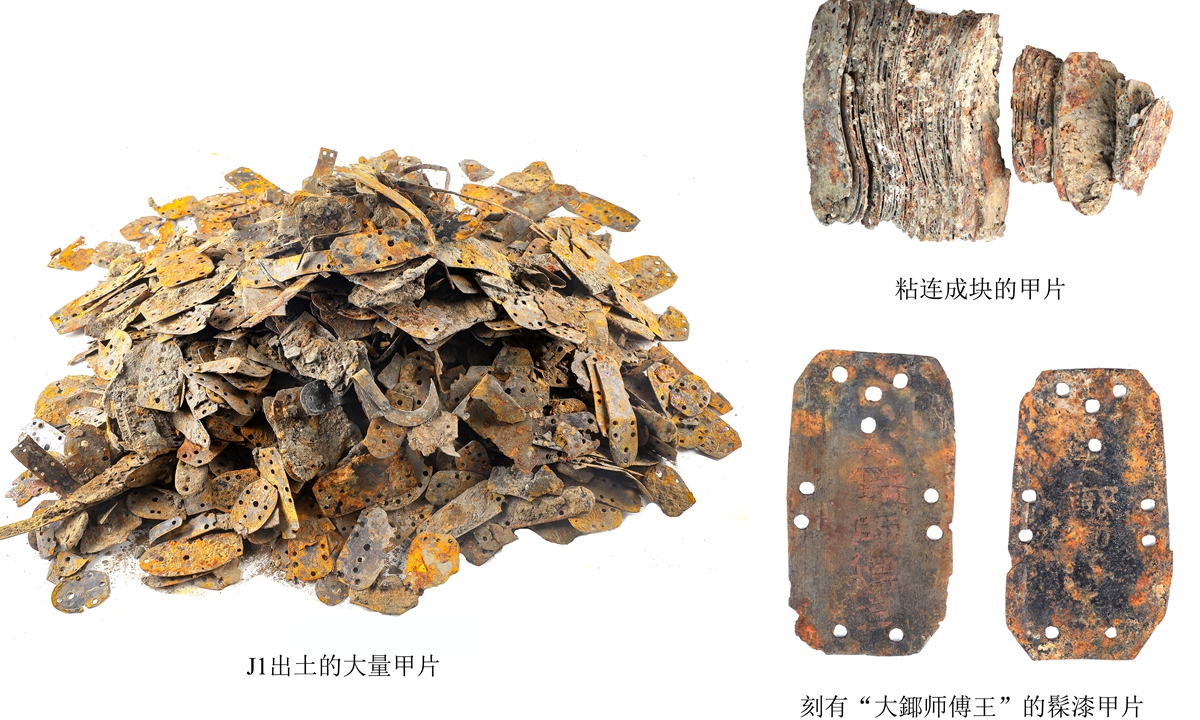
A number of tinned iron armor plates excavated from the Jizhong site Photo: Courtesy of the Shaoxing Institute of Cultural Relics and ArchaeologyArchaeologists at the Jizhong ruins site in Shaoxing, East China's Zhejiang Province, recently unearthed a large number of tinned iron armor plates and semi-finished pieces dating to the Wu period of the Three Kingdoms (222-280), according to the Shaoxing Institute of Cultural Relics and Archaeology. These discoveries represent the earliest known tinned iron artifacts in China to date, as well as the earliest tinned iron production remains found anywhere in the world, proving that an organized, systematic craft industry for tin-plated ironwork existed at that time.
While China has a long history of making tinned bronze and tinware, there has long been a lack of reliable historical records or physical evidence to prove early local production of tinned iron artifacts. The newly discovered armor plates can fill this gap, demonstrating that, by no later than the Wu period, local craftspeople in Zhejiang Province had mastered the art of tin-plating iron surfaces. This reflects the region's advanced metallurgical skills at that time, Ge Shuaikun, a researcher at the Shaoxing Institute of Cultural Relics and Archaeology, told the Global Times on Tuesday.
Over the last three years, archaeologists working at the Jizhong ruins site have excavated hundreds of tinned iron armor plates from ancient wells and ash pits. A preliminary investigation confirmed that the surfaces of these plates contain high levels of tin. Subsequent laboratory analyses were conducted in collaboration with the Shaoxing's institute and the Institute for Cultural Heritage and History of Science & Technology at the University of Science and Technology Beijing with methods such as Scanning Electron Microscopy with Energy Dispersive Spectroscopy (SEM-EDS), X-ray Diffraction (XRD), and Micro-CT to deeply examine the samples' materials, structures, and technological traces.
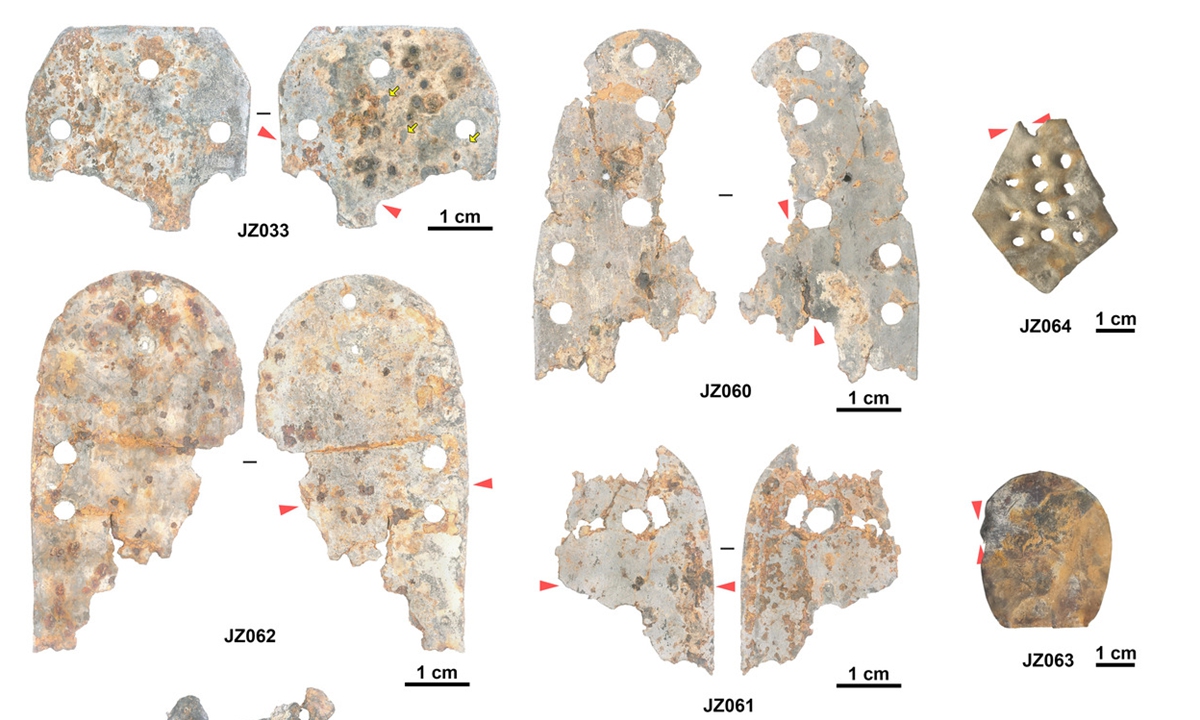
Photo: Courtesy of the Shaoxing Institute of Cultural Relics and ArchaeologyAccording to Ge, tin is a non-toxic metal with a low melting point, excellent corrosion resistance, and a silvery sheen. Tin plating effectively prevents rust, making iron armor far more durable and indeed, even after being buried for 1,700 years, many of these tinned plates retain their silvery metallic shine.
Research shows that the craftspeople immersed iron armor plates in molten tin, thus ensuring complete coverage of the surface with a continuous tinned layer. This coating isolated the iron from exposure to air and moisture, dramatically boosting corrosion resistance. Many of the excavated tinned armor pieces still show a clear, bright silver-white finish.
One major reason for tin-plating the armor was to prevent rust. At the same time, the silvery white shine of tinned iron offered a more striking, beautiful appearance, standing out from the typical dark iron armor of the era. This visual distinction may have marked these pieces as a higher-grade military asset, according to an article from the University of Science and Technology Beijing's official website.
The article said that in earlier eras, from the pre-Qin to Han dynasties, tin was widely used as a surface coating on bronzeware and ceramics. Researchers believe the tin-plating of iron armor discovered at the Jizhong ruins site during the Wu period of Three Kingdoms built upon this local tin-coating tradition, representing an adaptation of those techniques across different materials. The process likely benefited from technological exchange among various specialized workshops at the site, including those making bronze castings, iron weapons, and other metallurgical products.
。 本报讯 山洪沟治理工程既是一项重大的民生工程,也是一项重大的生态工程。今年,龙港区围绕保障和改善民生,推进山洪沟防洪治理,提升山洪灾害防御能力,筑牢“安全堤坝”。
烈日当空、骄阳似火。近日,笔者在荒地河山洪沟治理工程现场看到,河道内水波荡漾,两岸建起一块块可栽绿植的生态框,框架内部可以实现孔隙排水,使水分迅速排出,可以有效防止坡面积水和雨水渗透导致坡面坍塌。
据了解,荒地河全长4500米,治理长度3000米,南起荒地村外,北至锦葫路,其中固滨石笼护岸2200米,生态框1600米。目前,山洪沟防洪治理项目主体工程已完工。不仅能有效提升河道防洪行洪能力,还能改善沿岸人居环境及生态环境,提高区域绿化空间,绘就河畅水清岸绿景美的生态画卷。

二 |
据区农业农村局副局长介绍,山洪沟原貌基本处于土质岸坎无防护状态,暴雨后易造成河水漫灌、河道淤积、水土流失严重等灾害,威胁河道两岸群众安全,现在在河岸两侧使用了生态框与固滨笼相结合的方式进行治理,有效减缓了洪水冲刷力,使生态环境和水土保持得到改善。通过这项治理将有效预防安全隐患,保证河道行洪安全。(赵家艺)。
Current article:http://yyssfk.xiongpeiduanlouduoennongleng.cyou/news/20260826_2400.html
Published on:16:43:42


